

The Wretched of the Mirror
How Fanon warned that modern politics would teach us to fear ourselves

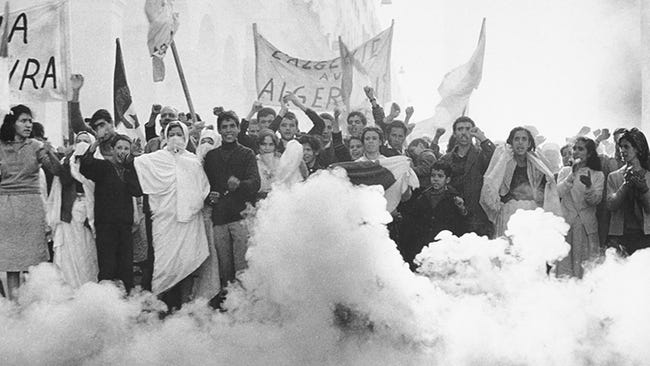
Revolution rarely looks pure on film, it appears as a reflection. Gillo Pontecorvo’s masterpiece, The Battle of Algiers (1966), shot in documentary style and scored by Ennio Morricone, dramatizes the Algerian struggle for independence from France. It follows both the insurgents of the National Liberation Front (FLN) and the French paratroopers sent to crush them, showing how violence and repression begin to resemble each other until the boundary disappears. In the film’s final scenes, the divided neighborhoods, the veiled women, the street vendors, and the students—people separated by class, gender, and belief—rise together. The occupation that once splintered them produces a unity born of shared exhaustion and shared recognition.
What was once difference becomes coordination; what was once silence becomes a collective voice.
That is the bridge to Frantz Fanon. The Battle of Algiers stages what The Wretched of the Earth diagnoses: liberation begins only when the internal divisions created by domination are refused. Fanon’s warning reaches beyond Algeria. He saw that political independence could easily become the new colonialism of the mind, and politicians, eager to preserve their own position, would learn to turn the people against themselves.
The Return of the Old Grammar
When The Wretched of the Earth appeared in 1961, Frantz Fanon wrote from the threshold between revolution and disappointment.
Independence movements were replacing colonial governors with national ones, and Fanon saw, more clearly than anyone, that political freedom could collapse into a subtler form of domination.
He argued that liberation fails not when the colonizer refuses to leave, but when the newly free society inherits his habits of control. Power adapts; it learns to rule through symbols, identity, and fear.
Fanon called this the tragedy of the national bourgeoisie, an elite that “steps into the shoes of the former European bosses.”
Today, the mask has changed again: politicians, pundits, and media influencers have stepped into the shoes of that elite.
The Continuity of Division
In the colonial era, the administration maintained order by splitting the population—tribe against tribe, city against countryside. Fanon warned that post-colonial politicians would use the same method, turning difference into political insurance.
Our contemporary democracies perfect the technique. Instead of tribe, we have identity bloc1; instead of territory, timeline.
Digital capitalism rewards outrage and fragmentation because unity is unprofitable. The algorithm, no longer the army, now performs the old colonial function of keeping the crowd busy with itself.
When Fanon wrote that “the party ceases to be the expression of the nation and becomes the property of a clique,” he was describing the transition from liberation to client network. Substitute “party” with “platform,” and the sentence describes the political internet.
The Bourgeoisie of the Screen
Fanon’s critique of the national bourgeoisie—educated, imitative, economically dependent—finds its echo in today’s professional class of communicators.
They mediate between citizens and power, translating anxiety into content. Their role is to narrate the system, soothing the public with an illusion of participation.
They speak in moral language while performing economic loyalty. The moral spectacle—culture war, the churn of scandal, virtue signaling2—is how the new bourgeoisie masks its dependence on corporate structures.
Fanon saw this pattern early:
“They have nothing better to do than take over the colonial companies and continue the same exploitation.”
Psychological Capture
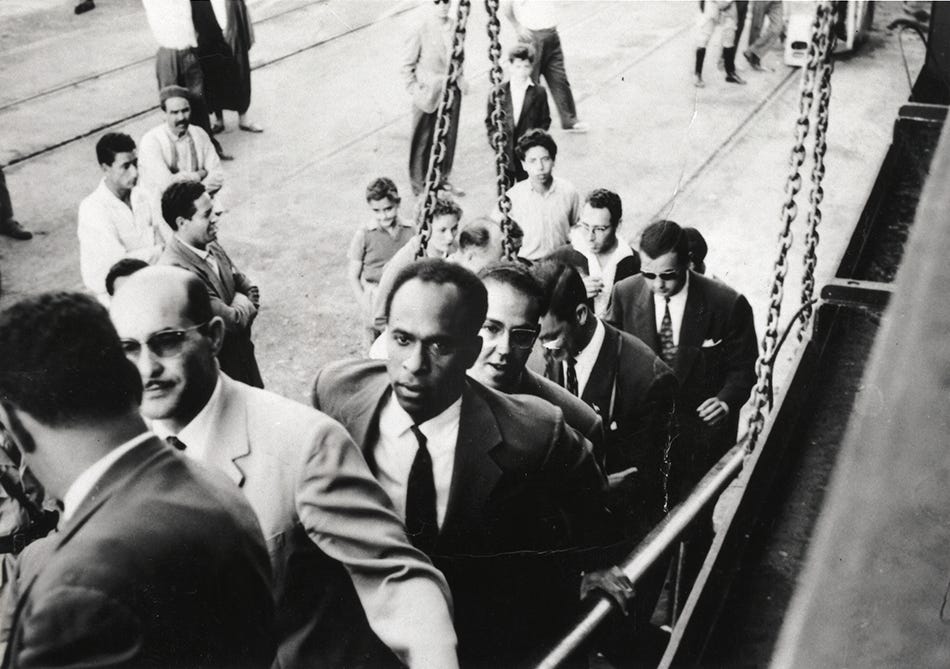
Trained as a psychiatrist, Fanon understood domination as a mental arrangement before it was a political one.
Colonialism, he wrote, implants self-doubt so deeply that the colonized begin to imitate their oppressors. The post-colonial politician reproduces that psychology by teaching citizens to mistrust one another.
In our time, the mechanism is personal. Polarization is no longer a side effect—it is the business model. Every conflict yields data; every grievance reinforces the system that monetizes it.
People are persuaded that their neighbor’s difference endangers their own identity. The result is a society that polices itself more efficiently than any state could.
The Disguises of Power
Fanon anticipated that post-colonial power would mask itself in the rhetoric of care.
“National unity,” “development,” “security”—these were the benevolent phrases that told which hierarchy continued.
Our equivalents are “connection,” “community,” and “safety.” The surveillance economy justifies itself as protection; exploitation arrives as intimacy.
This is not the end of colonialism but its digitization—the external frontier replaced by an internal one, drawn through the psyche.
The Possibility of Renewal
Fanon refused despair.
He called for a new humanism, built not on identity but on relation—
“to work out new concepts,” he wrote, “to set afoot a new man.”
In practical terms, that meant rebuilding solidarity at the level of the everyday:
cooperative labor, shared risk, local imagination.
Applied to our age, his prescription would sound deceptively simple: reconnect with the material world; refuse to be categorized by a market or a metric. Remember that politics is not a mood or frame of mind, but a mutual recognition.
Why It Matters Now
The danger Fanon named—the replacement of external domination by internal division—defines the twenty-first-century democracies that still call themselves free.
Every time political discourse collapses into cultural resentment, every time the working public blames itself instead of the system, that’s what they become.
We live inside the sequel to The Wretched of the Earth: a world where colonization has been privatized and the colony is our attention span.
Fanon demanded lucidity. His lesson endures because it is moral rather than strategic: the moment we begin to see one another as threats instead of potential allies, power has already won.
Coda: The Refusal of Division
To study Fanon today is not an academic exercise but a civic one. He reminds us that political maturity begins when we refuse to serve as instruments of someone else’s fear.
“We are not wretched because we are divided. We are divided so that we remain wretched.”
And the work of re-humanization, the quiet labor of refusing that logic, still waits to be done.
When users present themselves online through the information they share.
When users post about a cause they’ll never act on, display a donation receipt so others can see it, or watch a corporation recolor its logo as its practices stay the same; they’re performing conviction instead of practicing it.